
Gendering Social Robots: Color
Color
Color
Humans are quick to see robots as male or female. Researchers have shown that a few gender “cues” lead people to assign gender to a robot. One group found that a man’s black hat or pink earmuffs were enough for users to perceive a robot as male or female. Interestingly, when no cues were present, users perceived the robot as male (Jung et al., 2016). This may be because in a number of languages “robot” is masculine—for example, der Roboter (German), le robot (French).
Eye color
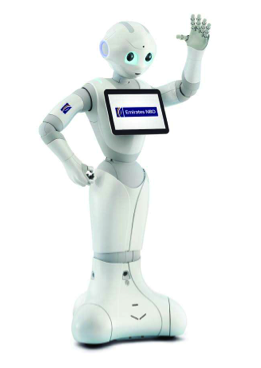 For example, blue or green eyes in robots, such as SoftBank’s Pepper, can suggest an ethnicity, in this case of European origins. Interesting, Pepper’s eyes change color to indicate listening behavior: navy blue when listening, green when not listening, pale blue/white when not listening. Designers can easily choose an eye color outside the human pallet.
Ethnicity
Experimenters have found that users are also sensitive to clues about ethnicity. Korean participants found a computer with a Korean face more attractive and trustworthy than one with a European-American face, showing a preference for same-ethnicity computer avatars (Nass & Moon, 2000).
Matachev et al. show that homophily—e.g., ethnic matching between robot and human—may enhance user task performance, but caution that overt labels of ethnicity, such as clothing, accent, or appearance, may offend certain groups. They found that ethnicity was best cued using verbal and nonverbal behaviors, such as conforming to norms of politeness in specific languages (2013; Eyssel & Kuchenbrandt, 2012).
We found no articles about how gender and ethnicity intersect in robots.