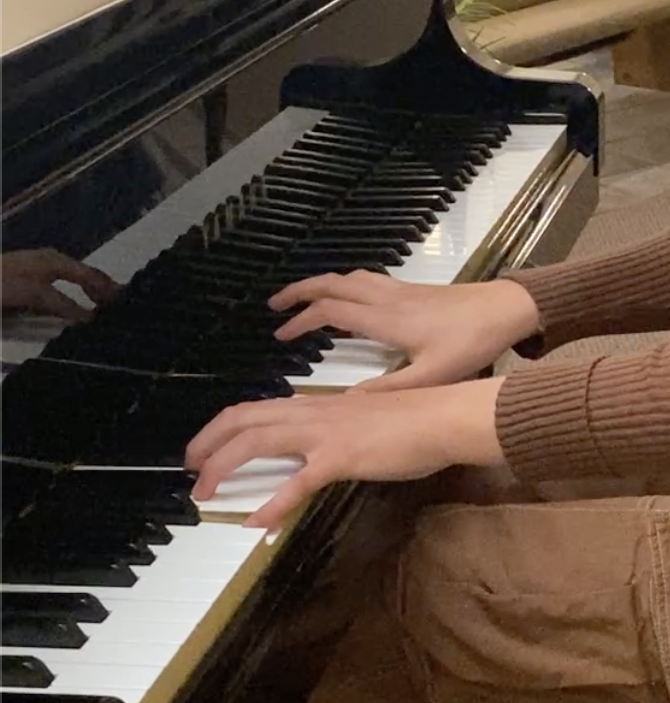
The one-size-fits-all standard piano keyboard does not, in fact, fit everyone. The current full-size piano keyboard was standardized in the 1880s through a close relationship between composers/virtuosi and piano manufacturers, such as Franz Liszt and Érard pianos. Liszt sported a 13-key hand span—much beyond that of most people. The result is that some that approximately 87% of women and 24% of men pianists have hand spans too small to comfortably play wide intervals (ninths or tenths) or rapid octaves on standard keyboards.
Women’s hands are, on average, some 11% smaller than men’s—very roughly 7/8 the size. More specifically, a 2015 study of 473 adult pianists found that men, on average, have a one-inch greater right-hand span (the maximum distance between the thumb and fifth finger) than women. Sex differences also intersect with ethnicity. Comparisons of people of European and Asian ancestry found that Europeans had somewhat larger hands, on average, than their Asian-identifying counterparts.
Gendered Innovations:
1. Understanding Injury for People with Smaller Hands. Professional pianists with small hands performing on standard instruments may suffer injury by using equipment that does not fit them. Understanding the biomechanics of such injuries can help prevent them. Pianists with small hands may also hit what has been identified as a “performance ceiling”—limitations in repertoire and, potentially, career opportunities.
2. A 7/8 Piano Keyboard, where an octave spans the physical distance of a 7th on a conventional keyboard, represents an ergonomic revolution that has begun to level the playing field in piano performance.
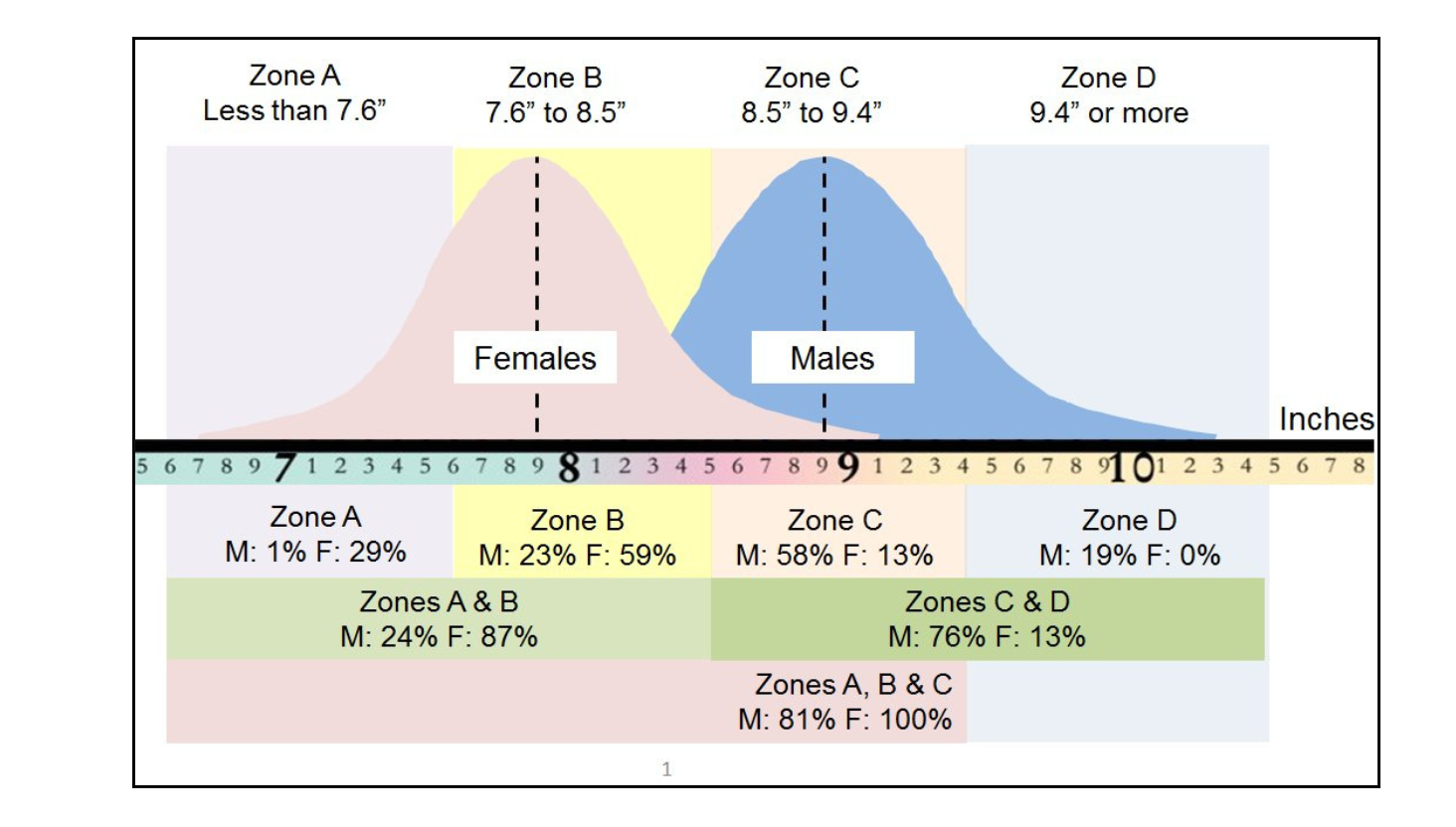
The one-size-fits-all standard piano keyboard does not, in fact, fit everyone. The current full-size piano keyboard was standardized in the 1880s through a close relationship between composers/virtuosi and piano manufacturers, such as Franz Liszt and Érard pianos. Liszt sported a 13-key hand span—much beyond that of most people. The result is that some 87% of women and 24% of men pianists have hand spans too small to comfortably play wide intervals (ninths or tenths) or rapid octaves on standard keyboards (Boyle et al., 2015).
At the same time, ever-larger concert halls demanded larger, more brilliant instruments—whose big sound was made possible by industrial-era cast-iron frames that withstood extreme stress from the high-tension steel and copper-wound bass strings. The modern 88-key piano keyboard was built to withstand the technical display pieces of the Romantic period virtuosi with their powerful, physically demanding performance styles (Booker & Boyle, 2011).
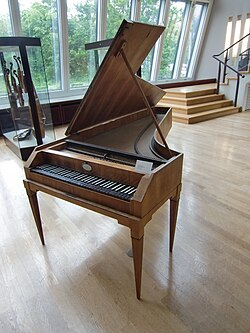
Historically, earlier keyboard instruments, including many eighteenth-century harpsichords, fortepianos, and pianos played by Wolfgang Amadeus Mozart and Ludwig van Beethoven, had narrower keys than today’s standard keyboard. The octave key span on the Anton Walter fortepianos favored by Mozart, for example, was about 6.2 to 6.4 inches, which is slightly narrower than the modern standard octave span of 6.5 inches on an 88-key keyboard (Sakai, 2008).
Fortepiano by Anton Walter & Sohn (Vienna, ca 1805) image from wiki, CC BY-SA 3.0 via Wikimedia Commons
Boyle et al. (2015), Figure 20. Pianist fingers 1-5 hand span ‘zones.’
Women's hands are, on average, some 11% smaller than men's—roughly 7/8 the size. A 2015 study of 473 adult pianists found that men have a right-hand span (the maximum distance between the thumb and fifth finger) that is, on average, one inch greater than women’s. It should be remembered that individual hand size is also related to overall height, and that there is considerable within-group variation. Sex differences also intersect with ethnicity. Comparisons of people of European and Asian ancestry found that Europeans had somewhat larger hands on average, with overall right-hand thumb-to-fifth-finger (1–5) span averaging 9.0 inches for European men, 8.7 inches for Asian men, 8.0 inches for European women, and 7.8 inches for Asian women (Boyle et al., 2015; Sakai et al., 2006).
View General Method
Gendered Innovation 1: Understanding Injury for People with Small Hands
Professional pianists with small hands performing on standard instruments may suffer injury by using equipment that does not fit them. As one critic remarked, “we would never expect a world-class athlete to compete with equipment that does not fit their body” (Hamilton, 2026).
Discussion of injuries related to playing standard keyboards with smaller hands began in the early 2000s (Boyle & Boyle, 2009). For example, when unable to comfortably play octaves, large chords, or arpeggios on standard keyboards, people with smaller hands may devise musical workarounds that involve extreme finger abduction, unusual muscle loading, twisted wrists, and awkward joint positions. The resulting playing-related musculoskeletal disorders include tendinopathies, nerve entrapment, muscle spasms, and chronic pain in the hands, arms, and shoulders. Although injuries arise from multiple factors—including practice duration, technique, and repertoire—small hand size has consistently been identified as an independent risk factor (Sakai et al., 2006). This video, Piano's Darkest Secret by Lionel Yu, is particularly interesting in demonstrating various musical workarounds.
Pianists with small hands performing on standard instruments may also hit what has been identified as a "performance ceiling." Elizabeth Schumann and C. Karen Liu at Stanford University collected the first large-scale 3D hand-motion dataset of elite pianists to understand the forces involved in the hand movements and how those change with different hand sizes and keyboard widths (Wang et al., 2024; Xu et al., 2026). A later study quantified the performance ceiling—the maximum level of speed, force, volume, accuracy, reach, and dexterity a pianist can attain. It demonstrated that pianists with small hands playing on standard instruments may face limitations in repertoire and, potentially, career opportunities (Schumann, 2026). Future directions for this work include providing a computational tool for biomechanics studies and injury prevention.
Gendered Innovation 2: A 7/8 Piano Keyboard
An ergonomic revolution has begun to level the playing field in piano performance. This has taken the form of a “7/8” piano keyboard, where an octave is equivalent to a seventh on the standard keyboard.
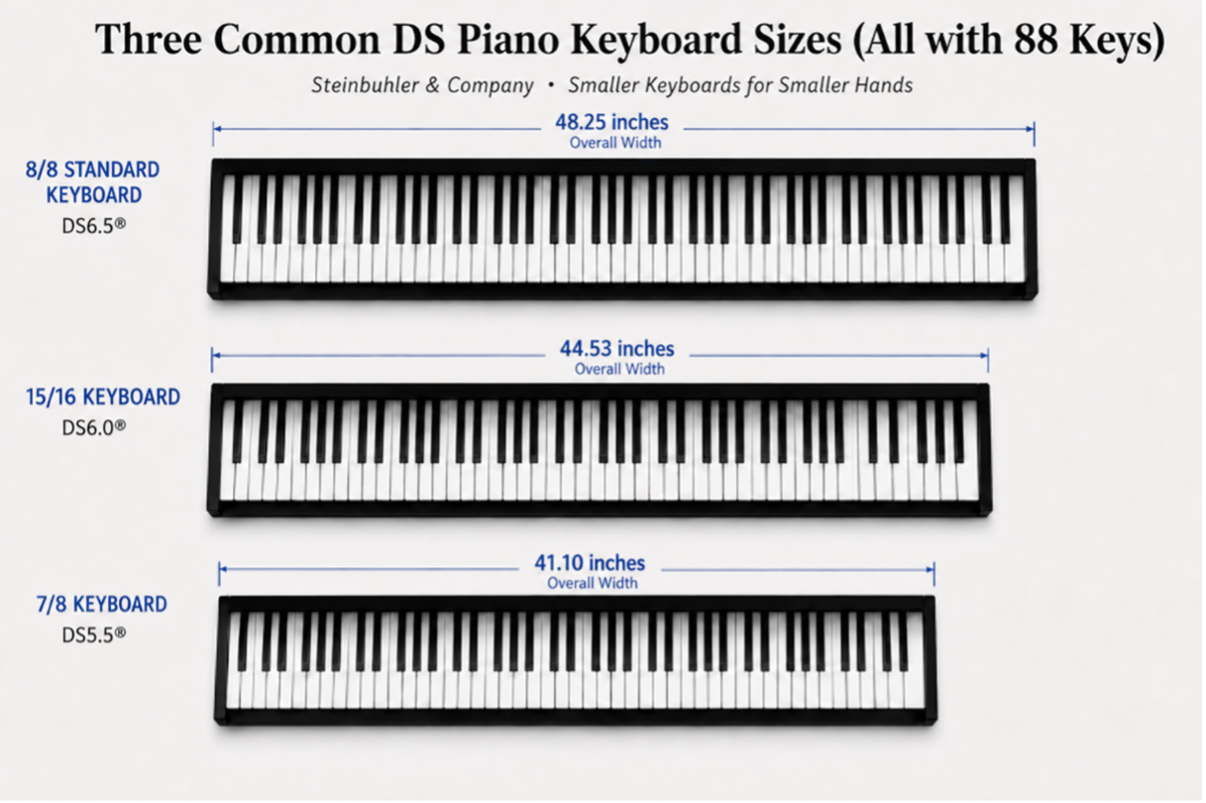
The modern 7/8 keyboard was developed in the 1970s by Canadian pianist Christopher Donison, who, as a music student, recognized that his small hand size limited his ability to master much of the standard piano repertoire. To address this issue, he commissioned and installed a specialized reduced-size keyboard in his grand piano (Donison, 1998). In the 1990s, inspired by Donison’s innovation, engineer David Steinbuhler transformed space within his family’s textile business into a workshop for designing and manufacturing piano keyboards with narrower keys, including both 15/16 and 7/8 sizes (Wristen & Hallbeck, 2009). The narrow keyboards, also known as “ergonomically scaled piano keyboards” (ESPKs), are now commonly referred to as Donison-Steinbuhler (DS) keyboards. The three common keyboard sizes are:
DS6.5® – the standard 8/8 keyboard with a 6.5-inch octave width (top image)
DS6.0® – the 15/16 keyboard with a 6.0-inch octave width (middle image)
DS5.5® – the 7/8 keyboard with a 5.5-inch octave width (bottom image)
From 1998 to 2005, Steinbuhler & Company (which became the DS Standard Foundation in 2018) invited pianists with different sized hands to come to their facility in Titusville, Pennsylvania, to determine what size piano keyboard was most comfortable for them. Linda and David Steinbuhler fit their Steinway with differently sized keyboards for the pianists—both adult men and women. After measuring numerous hands and experimenting with numerous keyboards, David Steinbuhler developed the now “standard” narrow keyboards—the DS6.0® or 15/16 keyboard and the DS5.5® or 7/8 keyboard. Using the same participatory method, the Steinbuhlers eventually added another four keyboard sizes for children (Steinbuhler & Steinbuhler, n.d.).
Importantly, the 7/8 keyboard reduces the width of each key by 14.8% but preserves the same 88 notes, fingering patterns, and musical relationships as a standard keyboard, meaning that pianists are able to perform traditional piano repertoire. Also important is that Steinbuhler developed the narrow keyboards to be easily interchanged with conventional keyboards—in grand pianos (uprights are more difficult to fit). This allows a university or concert hall to buy a single grand piano that can serve players of different hand sizes. The DS Standard Foundation supplies a 15/16 or 7/8 keyframe and action built to fit that instrument alongside its original 8/8 keyboard. These keyboards are easily swapped out by a local technician according to the needs or preferences of any performer or student (Leone, 2015).
Conclusion and Next Steps
The new narrow keyboards are an important innovation in inclusive design. They allow talented musicians to perform demanding repertoire without unnecessary physical strain.
These reduced-width keyboards can reduce injuries and alleviate pain among pianists (Chi et al., 2021).
The conventional piano keyboard is not the only thing that does not fit women’s or smaller people’s hands. First and foremost are surgical instruments, which have historically been designed to fit the average male hand, creating ergonomic challenges for many women surgeons. Glove sizes for male surgeons range from 7.0 to 7.5, while glove sizes for female surgeons range from 6.0 to 6.5. Because women tend to have smaller hand dimensions and lower grip strength than men, instruments developed without sex-specific considerations may cause stress injuries and pose professional barriers for women. The predominantly right-handed design of these instruments may also be a problem. Manufacturers are now introducing smaller-scale surgical instruments and alternative handle configurations that incorporate narrower shafts and, where needed, handles anatomically suitable for left-handers. These innovations in inclusive design aid surgeons while also improving patient outcomes (Putnam et al., 2024; Bitar et al., 2025).
There are many examples of things that do not fit women and may lead to unnecessary injury. For example, women’s soccer cleats were traditionally smaller versions of men’s shoes. Today, several companies offer cleats specifically engineered for women, typically with narrower heel cups and wider toe boxes (Prempeh & Pennington, 2025). Similarly, bicycle saddles have historically been optimized for male anatomy and riding positions—problems that have now been addressed through sex-specific designs (Herrero-Molleda et al., 2024).
Bitar, E. R., Hassanieh, J., Rahhal, S., Zaiter, B., & Zaghal, A. (2025). Handedness in surgical education: evaluating suturing proficiency among left- and right-handed trainees. Surgery Open Science, 24, 51-57.
Booker, E., & Boyle, R. (2011). Piano keyboards–one size does not fit all! Pianistic health for the next generation. In 10th Australian Piano Pedagogy Conference Proceedings.
Boyle, R., & Boyle, R. (2009). Hand size and the piano keyboard. Literature review and a survey of the technical and musical benefits for pianists using reduced-size keyboards in North America. Proceedings of the 9th Australian Piano Pedagogy Conference, Sydney, Australia.
Boyle, R., Boyle, R., & Booker, E. (2015). Pianist hand spans: gender and ethnic differences and implications for piano playing. In Australian Piano Pedagogy Conference, Melbourne, Australia.
Chi, J. Y., Halaki, M., Booker, E., Boyle, R., & Ackermann, B. J. (2021). Interaction between hand span and different sizes of keyboards on EMG activity in pianists: An observational study. Applied Ergonomics, 97, 103518.
Donison, C. (1998). Small hands? Try this keyboard, you’ll like it. Piano & Keyboard, July-August, 41-43.
Hamilton, K. (2026, July 8). Research questions piano’s one-size-fits-all keyboard, Stanford Report.
Herrero-Molleda, A., Bini, R., & García-López, J. (2024). Saddle preferences and perceived comfort of competitive women cyclists. Science & Sports, 39(8), 670-677.
Leone, C. (2015). Size Is Key: Which Size Fits You Best? Clavier Companion, 11-20.
Prempeh, M., & Pennington, C. G. (2025). Deconstructing Soccer Footwear: An Anatomical Review with Implications for Female Athlete-Specific Design. Universal Journal of Sport Sciences, 5(1), 24-30.
Putnam, J. G., Kerkhof, F. D., Shah, K. N., Richards, A. W., & Ladd, A. (2024). Helping surgeons’ hands: a biomechanical evaluation of ergonomic instruments. The Journal of Hand Surgery, 49(9), 933-e1.
Sakai, N. (2008). Keyboard span in old musical instruments: Concerning hand span and overuse problems in pianists. Medical Problems of Performing Artists, 23(4), 169-171.
Sakai, N., Liu, M. C., Su, F. C., Bishop, A. T., & An, K. N. (2006). Hand span and digital motion on the keyboard: concerns of overuse syndrome in musicians. The Journal of Hand Surgery, 31(5), 830-835.
Schumann, E. (2026, August), personal communication.
Wang, R., Xu, P., Shi, H., Schumann, E., & Liu, C. K. (2024, December). FürElise: Capturing and physically synthesizing hand motion of piano performance. In SIGGRAPH Asia 2024 Conference Papers (pp. 1-11).
Wristen, B., & Hallbeck, M. S. (2009). The 7/8 piano keyboard: an attractive alternative for small-handed players. Update: Applications of Research in Music Education, 28(1), 9-16.
Xu, P., Ye, Y., Sun, S., Ding, Y., Schumann, E., & Liu, C. K. (2026). MUSIC: Learning Muscle-Driven Dexterous Hand Control. ACM Transactions on Graphics (TOG), 45(4), 1-20.